
The Centers for Medicare & Medicaid Services (CMS) recently released data on its 2025 settlements of voluntary self-disclosures related to past violations or potential violations of the physician self-referral law (the Stark Law). Generally, two notable items arise from our annual review of CMS’ settlement data. First, CMS has now reported aggregate settlements reaching $105,090,031. Second, CMS reported the largest Stark Law settlement: $2,683,066 more than doubling the previous record high of a single settlement from 2018. Read on for more with respect to the CMS settlement data and potential lessons.
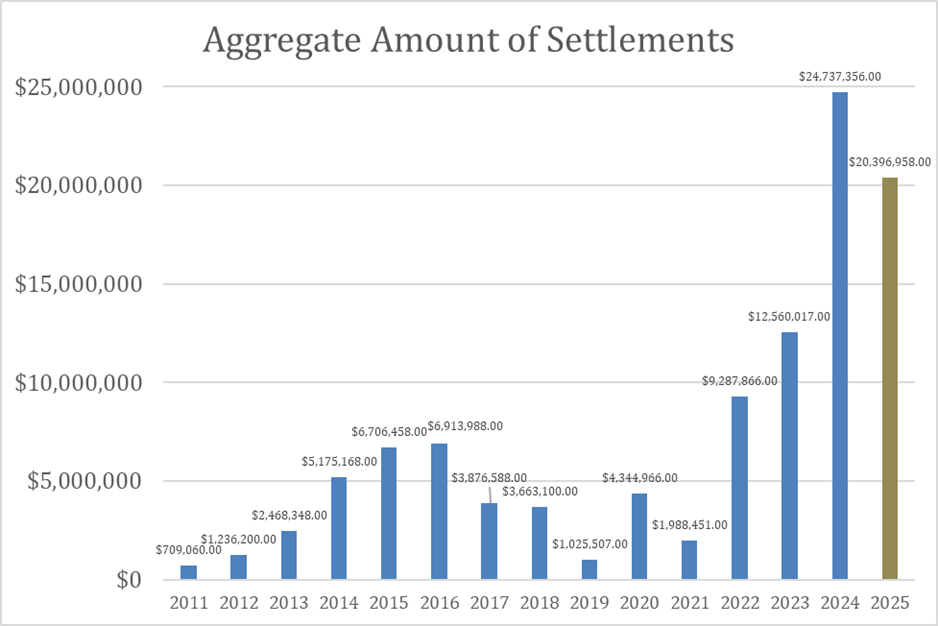
In 2025, CMS settled 244 self-disclosures, with settlement amounts totaling over $20,396,958 in the aggregate. This represents a decrease from the record-breaking 314 settlements in 2024 that had an aggregate total of $24,737,356, but the 2025 totals remain among the highest in the program’s history and reflect CMS’ continued commitment to processing self-referral disclosure protocol (SRDP) submissions. Notably, 2025 produced the highest individual settlement amount on record, with settlement amounts in 2025 ranging from $2 to $2,683,066. This new record individual settlement represents a significant outlier and demonstrates the potential magnitude of liability that can arise from Stark Law violations.
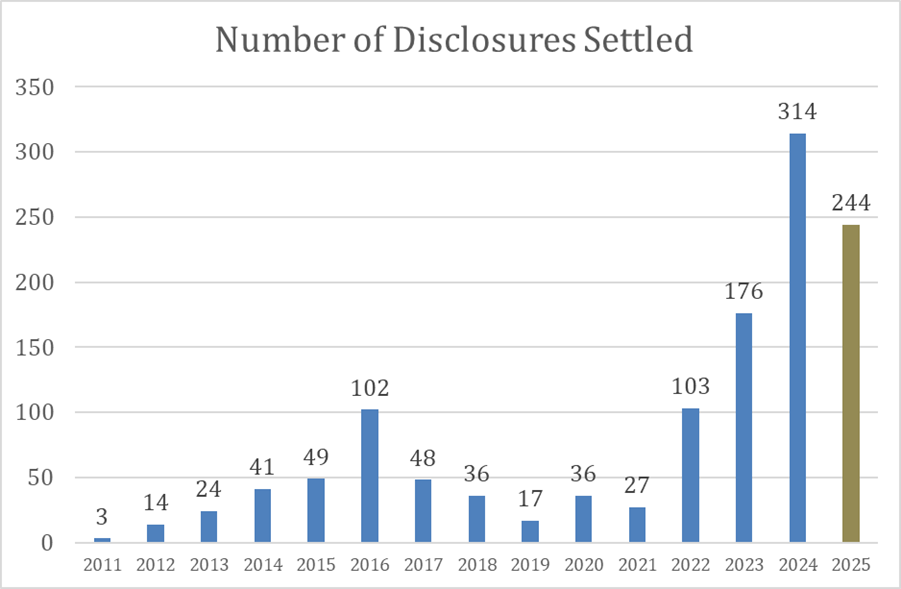
As of December 31, 2025, CMS settled a total of 1,234 SRDP submissions since the SRDP’s inception in 2011. Additionally, 373 disclosures have been withdrawn, closed without settlement, or settled by CMS’s law enforcement partners.
This represents a total of aggregate settlements reaching $105,090,031, since 2011, with amounts in the last four reported years exceeding every year prior under the SRDP process.
Background
SRDP submissions stem from the highly technical Stark Law, which generally prohibits a physician from making a referral for designated health services (which include clinical laboratory services, radiology and certain other imaging services, and durable medical equipment and supplies) payable by Medicare to an entity with which the physician (or an immediate family member of the physician) has a financial relationship, unless an exception is satisfied. The Stark Law has strict liability consequences and violations are often inadvertent. Therefore, at the direction of Congress, CMS created the voluntary SRDP for healthcare providers and suppliers to self-disclose actual or potential violations of the Stark Law to resolve overpayment liability for the disclosed conduct.
As CMS does not report on individual settlements, we closely monitor the annual information related to SRDP settlements to determine if there are trends or other information that can be helpful when advising on how best to address technical Stark Law concerns. Because disclosures of actual or potential violations of the physician self-referral law include proprietary, confidential, or otherwise nondisclosable information, CMS presents settlement information on an aggregate basis.
Continued Processing Efficiency
The sustained high volume of settlements in 2024 and 2025 demonstrates CMS’s continued focus and efforts to work through SRDP submissions more expeditiously than in the past. Our anecdotal experience reinforces this trend, as we have seen responses to submissions and settlements occurring on a more rapid basis than in prior years. In fact, some settlements are offered to clients the same calendar year as the SRDP submission. This is a material change from earlier in the decade when a historic backlog led many providers to experience significant waiting periods.
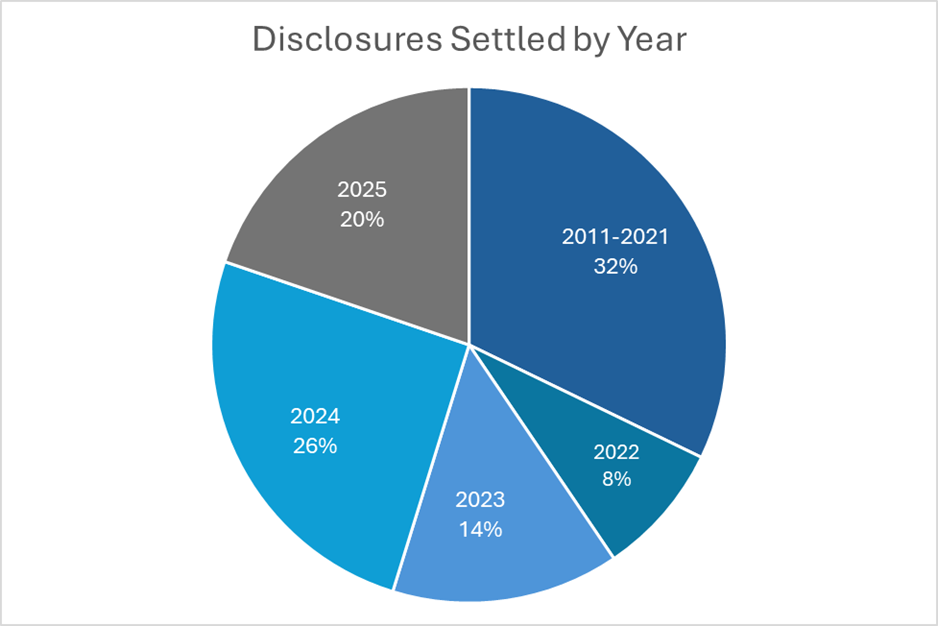
The Disclosures settled by year further demonstrates the pace CMS has maintained in processing disclosures post-Covid. In the last two years, CMS has settled nearly half of all disclosures since 2011. The last four years represent 67.8% of all settlements, and 63.7% of the settlement dollars. On the other hand, the slight decrease compared to 2024 ends a three-year trend where CMS settled more disclosures year-over-year.
Average Settlements
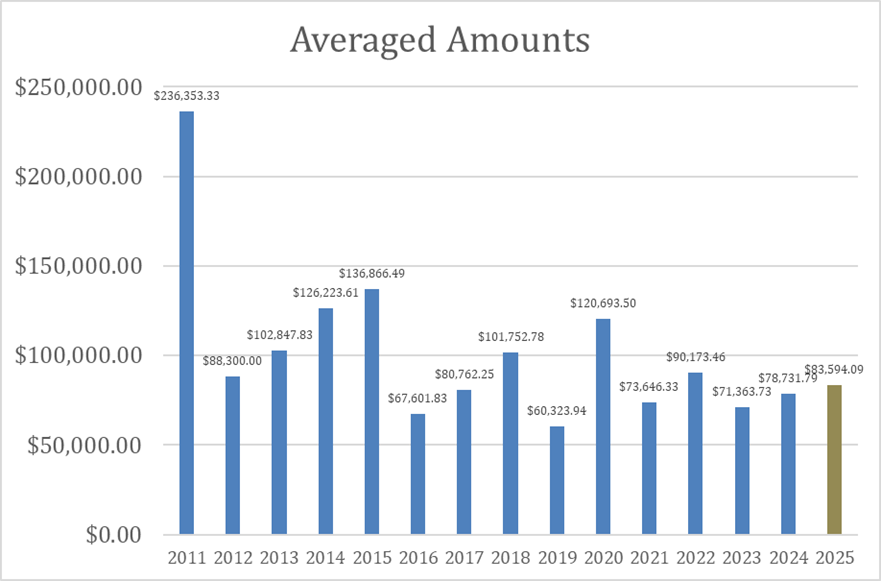
This year, in addition to the records described above, we note that the average settlement number $83,594.09 in 2025 is well within the range that we have seen in recent years, as reflected in the chart below. Indeed, this is very close to the 2021 and 2024 averages, suggesting that the range of settlements appear to continue to converge (though we recognize that a settlement number is fact-dependent, and these averages may just be coincidental based on specific submissions).
Key Takeaways
The 2025 settlement data provides several important observations for providers considering or engaged in the SRDP process. First, while the number of settlements decreased from the record 314 in 2024 to 244 in 2025, this still represents the second-highest annual settlement total in program history and suggests CMS continues to prioritize clearing its SRDP backlog.
Second, the record-high individual settlement of $2,683,066 in 2025 is a notable development. This eclipses the prior record of $1,196,188 from 2018 by more than double and serves as a reminder that settlement amounts remain highly fact-dependent. A number of factors may contribute to the exact numeric value of a specific settlement, and one or two outliers with very high or low settlement values can skew the average settlement amount. Indeed, the lowest settlement last year was $2.
Third, the aggregate settlements exceeding $100 million since 2011 underscore the significant financial implications of Stark Law compliance and the importance of proper arrangement structuring. The sustained high settlement numbers in 2024 and 2025 give those considering the SRDP process further context that settlement may come quicker than a decade ago. It also shows the SRDP process continues to be a viable path for providers and suppliers, commonly used by the industry.
We will continue monitoring CMS statements on SRDP settlements in future years to examine what other trends the provider community may be able to glean from these announcements.